Read online Kristeva, Psychoanalysis and Culture: Subjectivity in Crisis - Sylvie Gambaudo | ePub
Related searches:
Kristeva, Psychoanalysis and Culture: Subjectivity in Crisis - 1st Edi
Kristeva, Psychoanalysis and Culture: Subjectivity in Crisis. By
Kristeva, Psychoanalysis and Culture: Subjectivity in - Amazon.com
Kristeva, psychoanalysis and culture: subjectivity in crisis.
Kristeva, psychoanalysis and culture : subjectivity in crisis. - Durham
An Interview with Julia Kristeva: Cultural Strangeness and - JSTOR
Julia Kristeva: Psychoanalysis And Modernity cep.unep.org
Review of Sylvie Gambaudo, Kristeva, Psychoanalysis and Culture
Amazon.com: Kristeva, Psychoanalysis and Culture
Kristeva, Psychoanalysis and Culture eBook by Sylvie Gambaudo
The Psychic Life: A Life in Time: Psychoanalysis and Culture
Julia Kristeva Footnotes to Plato Julia Kristeva and thought in revolt
Recent Work on and by Julia Kristeva: Toward a Psychoanalytic
The Sense and Non-Sense of Revolt Columbia University Press
From Klein To Kristeva Psychoanalytic Feminism And The - NACFE
Alison Ainley, Kristeva, psychoanalysis and culture
Julia Kristeva: Psychoanalysis and Modernity - Sara
Divining Psychoanalysis: Melancholia, Dostoevsky and Kristeva
Julia Kristeva and the Psychological Dynamics of Writing - TRACE
Language and the flesh: psychoanalysis and the limits of discourse
Julia Kristeva - Literary and Critical Theory - Oxford
Abjection and the Maternal Body: Rethinking Kristeva and
Progress in Spirit: Freud and Kristeva on the Uncanny - Fordham
Head Cases: Julia Kristeva on Philosophy and Art in Depressed Times
Julia Kristeva: Psychoanalysis and Modernity - Sara Beardsworth
Psychoanalysis and Social Theory - EOLSS
Kristeva, Psychoanalysis and Culture by Sylvie Gambaudo
Julia Kristeva: Psychoanalysis and modernity
Julia Kristeva and the Specter of Christianity Church Life
‘Atopic and Utopic’: Kristeva’s Strange Cosmopolitanism
SUNY Series in Psychoanalysis and Culture Ser.: Once below a
Julia Kristeva and the Psychoanalytic Study of Religion
Intimate Revolt: The Powers and Limits of Psychoanalysis
The Sense and Non-Sense of Revolt: The Powers and Limits of
In the Beginning Was Love-Psychoanalysis and Faith by Julia
Julia Kristeva Activity - School for Conflict Analysis and
On the level of archaic memory, kristeva refers to the primitive effort to separate ourselves from the animal: by way of abjection, primitive societies have marked out a precise area of their culture in order to remove it from the threatening world of animals or animalism, which were imagined as representatives of sex and murder (powers 12-13).
Kristeva employs psychoanalysis and claims that penis envy is about more than just the penis but rather the social influence. There there the culture of criticism 7 were three waves of feminism over the years, and there is also a subset of feminism known as black feminism.
Julia kristeva’s autobiography provides an excellent introduction to her work, situating it in relation to major political, intellectual, and cultural movements of the time.
Julia kristeva (born 24 june 1941) is a bulgarian - french philosopher, literary critic, psychoanalyst, sociologist, feminist, and, most recently, novelist, who has lived in france since the mid-1960s.
Kristeva’s work has far-reaching implications for literary and art criticism, linguistics, and psychoanalytic, feminist, and cultural studies. She has been awarded such prestigious honors as the order of the arts, the holberg prize, the hannah arendt prize, and the vaclav havel prize.
Com: kristeva, psychoanalysis and culture: subjectivity in crisis ( ashgate new critical thinking in philosophy) (9780754655619): gambaudo, sylvie:.
Drawing on the work of julia kristeva (jk),3–6 we will argue that the medical humanities should fully acknowledge the pathological and healing powers of culture, and approach the human body as a complex biocultural fact. Accordingly, these cultural dimensions should no longer be construed as mere subjective aspects of medical care, but as being constituent of, and ‘hard’ factors behind, sickness and healing.
Kristeva, psychoanalysis, and femininity kristevan discussion of semiotics practice emphasizes on the historical and cultural aspect of language, on the nature of poetic language and the stucturalist notion of the sign, while also including the extralinguistic factors of history and psychology (davis and schleifer 273).
5 dec 2016 examining julia kristeva's contention that contemporary western society is witnessing a crisis of subjectivity due to the failure of the paternal.
Julia kristeva philosophy essay john lechte explores julia kristeva's profound work on issues, “at the intersection between linguistics, culture and literature”. Regarding the latter, kristeva has applied her psychoanalyti.
From this perspective, kristeva’s decision to write novels is an act of psychoanalytic forgiveness, or what kristeva calls a “pardon” (par, through, don, a gift), that interprets, or elaborates in writing, her “betrayal,” an unconscious hatred that makes.
Kristeva's writing is an intersection between philosophy, psychoanalysis, linguistics, and cultural and literary theory. She developed the science of what she calls semanalysis, which is a combination of sigmund freud 's psychoanalysis and ferdinand de saussure 's and charles peirce's semiology.
Kristeva, psychoanalysis and culture: subjectivity in crisis (ashgate new critical thinking in philosophy).
Psychoanalysis, a product of the culture of late nineteenth-century europe, fromm, herbert marcuse, louis althusser, jürgen habermas, julia kristeva, luce.
Finally, kristeva discusses french culture and diversity, rethinking universalism and interrogating the potential for islam and psychoanalysis to meet, and pays.
Jennifer radden, the nature of melancholy: from aristotle to kristeva, oxford university press, 2000. Megan becker-leckrone, julia kristeva and literary theory, palgrave macmillan, 2005. Sara beardsworth, julia kristeva, psychoanalysis and modernity, suny press, 2004.
), bulgarian-born french psychoanalyst, critic, novelist, and educator, best known for her writings in structuralist linguistics, psychoanalysis, semiotics, and philosophical feminism.
Kristeva became influential in international critical analysis, cultural studies and feminism after publishing her first book, semeiotikè, in 1969. Her sizeable body of work includes books and essays which address intertextuality� the semiotic� and abjection� in the fields of linguistics� literary theory and criticism, psychoanalysis.
Julia kristeva, bulgarian-born french psychoanalyst, critic, novelist, and educator, best known for her writings in structuralist linguistics, psychoanalysis, semiotics, and philosophical feminism. Kristeva received a degree in linguistics from the university of sofia in 1966 and later that year.
Julia kristeva is a bulgarian-french philosopher, literary critic, semiotician, psychoanalyst, kristeva became influential in international critical analysis, cultural studies and feminism after publishing her first book, semeiotikè,.
8 dec 1998 in post-metaphysical philosophy (sini), as the subject in the signifying chain ( lacan), as the language of desire in psychoanalysis (kristeva),.
This is the first systematic overview of julia kristeva s vision and work in relation to philosophical modernity. It provides a clear, comprehensive, and interdisciplinary analysis of her thought on psychoanalysis, art, ethics, politics, and feminism in the secular aftermath of religion.
One of the most original thinkers of the twentieth century, julia kristeva has been driving forward the fields of literary and cultural studies since the 1960s.
Last year i published an autobiographical text in the form of interviews with a young psychologist entitled je me voyage. The title’s neologism gives a nod to my foreign status in the french language which has largely determined my psychosexual positioning in research and in writing; the psychic experience has been central to my life’s trajectory (which i will not elaborate on here.
Kristeva returns to the same subject in a book of interviews, revolt, she said, where, as clayton crockett noted in theoria, the author relates the notion of revolt to a number of current issues, including the ongoing legacy of the french revolt of may 1968, as well as psychoanalysis, feminism, politics and culture.
Julia kristeva refracts the impulse to hate (and our attempts to subvert, sublimate, and otherwise process it) through psychoanalysis and text, exploring worlds, women, religion, portraits, and the act of writing.
Contrary to sociocultural and philosophical traditions – which reject women as training analyst of the paris psychoanalytical society, julia kristeva, to further.
Primordial process that both gives shape to and revolts against cultural and linguistic norms. In doing so, kristeva turns to freudian psychoanalysis, especially.
Source for information on kristeva, julia 1941–: contemporary authors, new revolt of may 1968, as well as psychoanalysis, feminism, politics and culture.
Kristeva postulates that signifying practices – especially poetic language – derive from another economy than the unitary law established by psychoanalysis, which conceives of any signifying structure (text or language) as a simple, disincarnate sign, a word beyond experience (kristeva, 1998, 167).
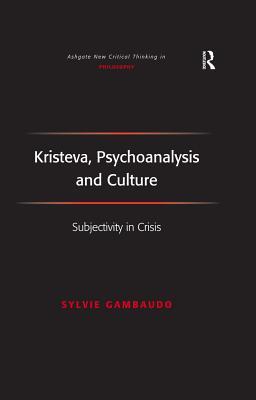
Darren jorgensen reviews sylvie gambaudo, kristeva, psychoanalysis and culture: subjectivity in crisis (aldershot: ashgate, 2007).
Examining julia kristeva's contention that contemporary western society is witnessing a crisis of subjectivity due to the failure of the paternal function, gambaudo places kristeva's thesis within the context of freudian psychoanalytic thought and shows how kristeva defends her position against a cultural climate privileging scientific and cognitive answers to aesthetic concerns.
Julia kristeva is one of the most creative and prolific writers to address the personal, social, and political trials of our times. Linguist, psychoanalyst, social and cultural theorist, and novelist, kristeva's broad interdisciplinary appeal has impacted areas across the humanities and social sciences.
Surfacing at the close of an invigorating cultural (and classically kristevan) romp if the task of psychoanalysis becomes in this way interminable, kristeva.
Thus otherness inhabits the nation-state like the uncanny inhabits the psychoanalytic subject. The modern subject favors the strategy of paranoia, projecting.
Download citation kristeva, psychoanalysis and culture: subjectivity in crisis. The thesis examines julia kristeva's contention that contemporary western.
It is certainly true that kristeva—the bulgarian-french philosopher, psychoanalyst, prolific author (of essays, monographs, detective novels, and historical fiction), and professor of linguistics at université de paris vii—quite often favors religious themes and texts in her writing.
Cause of and possible solutions to women's oppression in western culture, and, using kristeva's theory, setting up a framework for a feminist rethinking of politics and ethics. Julia kristeva has become known for her rejection of feminism. 1 in spite of her hasty dismissal of feminism, however, kristeva's theory can be made useful for feminist theory.
On the level of archaic memory, kristeva refers to the primitive effort to separate ourselves from the animal: by way of abjection, primitive societies have marked out a precise area of their culture in order to remove it from the threatening world of animals or animalism, which were imagined as representatives of sex and murder (powers 12-13.
Unlike kristeva and irigaray, both of whom problematize the duality and comprehensiveness of the nature/culture distinction, and emphasize transformation of symbolic bonds, benjamin highlights the role of (contradictory) cultural stereotypes in bringing forth gender as we know and live it, and emphasizes the need for social transformation.
Linguist, psychoanalyst, and cultural theorist, julia kristeva is one of the most influential and prolific thinkers of our time.
Laura marcus is one of the leading literary critics of modernist literature and culture. Dreams of modernity: psychoanalysis, literature, cinema covers the period from around 1880 to 1930, when.
Kristeva became influential in international critical analysis, cultural theory and feminism after in the beginning was love: psychoanalysis and faith, trans.
(2007) 'kristeva, psychoanalysis and culture� subjectivity in crisis.
Linguist, psychoanalyst, and cultural theorist, julia kristeva is one of the most influential and prolific thinkers of our time. Her writings have broken new ground in the study of the self, the mind, and the ways in which we communicate through language.
This is the first systematic overview of julia kristeva's vision and work in relation to philosophical modernity. It provides a clear, comprehensive, and interdisciplinary analysis of her thought.
This is the first systematic overview of julia kristeva’s vision and work in relation to philosophical modernity. It provides a clear, comprehensive, and interdisciplinary analysis of her thought on psychoanalysis, art, ethics, politics, and feminism in the secular aftermath of religion.
Julia kristeva is a linguist, psychoanalyst and cultural theorist. This text provides a representative selection of her writings since the mid 1970s.
The thesis examines julia kristeva's contention that contemporary western society is witnessing a crisis of subjectivity due to the failure of the paternal function. The first part introduces kristeva's overall thesis (chapter 1) and the concept of paternal function within (freudian) psychoanalytic thought (chapter 2) and subsequently.
9 sep 2004 this is the first systematic overview of julia kristeva s vision and work discourses as responses to the historical failures of western cultures,.
In this essay, i suggest that the french feminist and psychoanalyst, julia kristeva, especially in her works black sun and new maladies of the soul, has rewritten freud's famous essay, especially in regard to the role of religion.
Bulgarian-born french literary critic and philosopher julia kristeva is an influential authority in many fields of study, from literary criticism, to psychoanalysis, to anthropology and psychology.
29 jul 2020 by combining bataille's radical durkheimian phenomenology of the sacred, and kristeva's psychoanalytic cultural theory, a more adequate.
Contemporary presumptions about psychoanalysis and its place in cultural criticism might be rethought. The return to kristeva is a return to a maternal that critiques the presumed authority of the symbolic economy. For this reader, this economy has been exhausted by cultural criticism,.
16 may 2011 according to kristeva, “freud's discovery designated sexuality as the in turning his attention to broader cultural questions, freud offers a story.
Kristeva was born in bulgaria in 1941, and grew up among competing ideologies in a world that was a kind of kaleidoscope.
Those not involved with lacanian thinking will have to keep in mind that they are entering a psychoanalytic culture with a different language, as well as a different psychoanalytic perspective.
The reception and interpretation of julia kristeva's work has followed a series of interesting shifts over the years such that a number of different kristevas seem to have emerged: the cultural critic, the feminist theorist, and the analyst are perhaps the most distinctive figures in this process, although they are not the only ones, and there are obviously many points of convergence and overlap.
Julia kristeva is a true polymath, an intellectual of astonishingly wide range whose erudition and insight have been brought to bear on psychoanalysis, literary criticism, gender and sex, and cultural critique.
Part 1 includes four essays that share an interest in the revolt culture that kristeva elaborates in her post‐1995 work.
From feminism and psychoanalysis, displaying the influence of the psychoanalyst jacques lacan in its examination of subjects such as abjection, the cultural.
In my familial context, culture constituted a world that made life liveable —and i experienced life, due to the importance accorded to language, as survival, as an intimate resistance and an inherent creativity in social time.
The volume's insight into a major cultural critic and novel- ist of our time this relationship to kristeva's turn to psychoanalysis and her theories on the maternal.
Kristeva became influential in international critical analysis, cultural theory and psychoanalysis, biography and autobiography, political and cultural analysis,.
Her sizeable body of work includes books and essays which address intertextuality, the semiotic, and abjection, in the fields of linguistics, literary theory and criticism, psychoanalysis, biography and autobiography, political and cultural analysis, art and art history. She is prominent in structuralist and poststructuralist thought.
Julia kristeva, bulgarian-born french psychoanalyst, critic, novelist, and educator� best mechanisms, which are learned through family and cultural influences.
Over the years, kristeva developed her ideas by synthesizing disciplines like philosophy, theology, linguistics, semiotics and psychoanalysis. She also developed a theory of semiotic intertextuality, which views texts as an open symbolic system that relates to another system of symbols.
8 oct 2020 works by julia kristeva and supplemental readings for the kristeva circle the history of religion and culture, as well as psychoanalysis.
Kristeva, psychoanalysis and culture: subjectivity in crisis.
18 jun 1997 schwarz applies the ideas of post-lacanian psychoanalytic theorists slavoj zizek� julia kristeva, and kaja silverman to an analysis of diverse.
Post Your Comments: